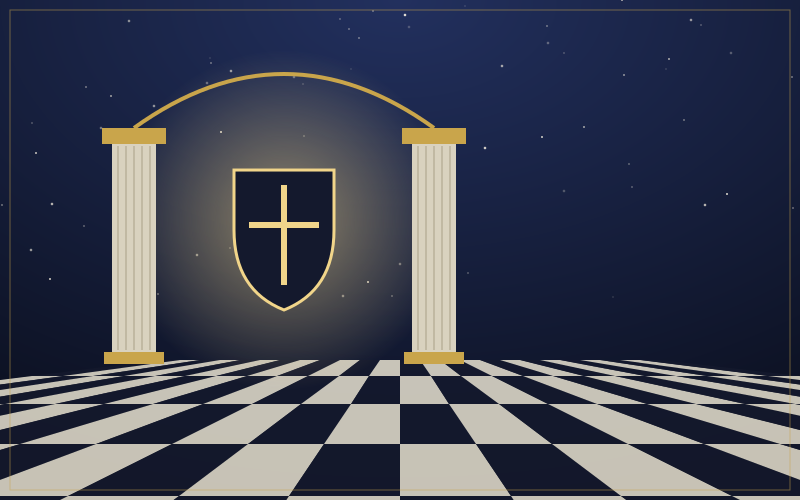
The Masonic lodge is a space built to be read. Every element, from the arrangement of the seats to the pattern of the floor, has a meaning that is explained progressively through the degrees. Knowing these symbols helps us understand not only Freemasonry but also the way eighteenth-century initiatory culture turned the objects of a trade into tools for moral reflection.
Orientation: East and West
The lodge is ideally a rectangle oriented from east to west. In the East sits the Worshipful Master, because that is where light rises. In the West and, in some rites, in the South sit the Wardens, who direct the work together with him. This arrangement recalls the orientation of temples and churches and makes the lodge a symbolic image of the cosmos.
The ritual catechisms say that the lodge extends in length from east to west, in breadth from north to south, in height to the heavens and in depth to the centre of the earth. It is a way of affirming that initiatory work concerns the whole world.
Square and compasses
The best-known symbol of Freemasonry is the union of square and compasses. The square is used to check right angles and represents rectitude in action. The compasses draw circles and measure distances, and symbolise the ability to set limits on one's desires and remain within due bounds.
In the rituals of many obediences the relative position of the two tools on the sacred book changes according to the degree. This detail visually indicates progress: what is hidden at first is gradually revealed.
The pillars Jachin and Boaz
At the entrance of the lodge stand two pillars, called Jachin and Boaz. The names come from the first book of Kings, which tells how two bronze pillars bearing these names were set up before the porch of Solomon's Temple. The traditional meaning of the names is linked to the idea of stability and strength.
The pillars mark a threshold: entering the lodge means passing between them, from a profane space into a ritual one. Pomegranates and lilies are often shown on the pillars, also taken from the biblical description.
The rough and perfect ashlars
Among the objects in the lodge are two stones:
- the rough ashlar, irregular, just taken from the quarry, representing man in his initial state;
- the perfect ashlar, or smooth ashlar, squared and ready for building, representing the man who has worked on himself.
The apprentice's work consists symbolically in dressing the rough ashlar. It is a simple and powerful image: inner transformation takes time, effort and the right tools.
The chequered floor
The floor of the lodge, or at least its central part, is often decorated with black and white squares. It is called the mosaic pavement. The most common reading associates it with the alternation of light and shadow, good and evil, joy and sorrow that makes up human life. Walking on it means acknowledging this duality without being ruled by it.
The blazing star and the letter G
In the centre or in the East, many rites display the blazing star, a five-pointed star from which rays stream out. Within it the letter G is often inscribed, which in the English-speaking tradition is linked to God and to Geometry, the science on which the art of building rests.
| Symbol | Origin | Traditional reading |
|---|---|---|
| Square | Mason's tool | Rectitude |
| Compasses | Architect's tool | Measure and limit |
| Pillars | Solomon's Temple | Threshold, stability and strength |
| Rough ashlar | Quarry | Man to be perfected |
| Perfect ashlar | Building site | Man who has worked on himself |
| Mosaic pavement | Temple decoration | Duality of experience |
| Letter G | English tradition | God and geometry |
The three lights and the three pillars
The rituals speak of three great lights: the sacred book, the square and the compasses. Alongside them are three lesser lights, often candles placed near the seats of the Master and Wardens. There is also talk of three pillars supporting the lodge: Wisdom, Strength and Beauty, sometimes represented by the Doric, Ionic and Corinthian orders of architecture.
The tracing board
In the eighteenth century the symbols were often drawn in chalk on the floor and rubbed out at the end of the meeting. Later, painted boards known as tracing boards became common, gathering the symbols of each degree into a single image. They are a teaching tool: the Master uses them to explain the meaning of the objects to new members.
Open symbols
A characteristic feature of Masonic symbolism is that the official explanations do not exhaust the meaning. The rituals offer a moral reading, but each member is invited to reflect and go deeper. The symbol, in this view, is not a code to be cracked once and for all, but an object to be contemplated over time.
In short
- The lodge is oriented from east to west and symbolically represents the cosmos.
- Square and compasses stand for rectitude and measure; their position varies with the degree.
- The pillars Jachin and Boaz derive from Solomon's Temple and mark the threshold.
- The rough and perfect ashlars represent work on oneself.
- The mosaic pavement, the blazing star and the tracing boards complete the symbolic language of the lodge.